Warm Weather
- 3.3
- Rating
- 5.00M
- Installs
- Free
- Price
 Analysis by App-foxy
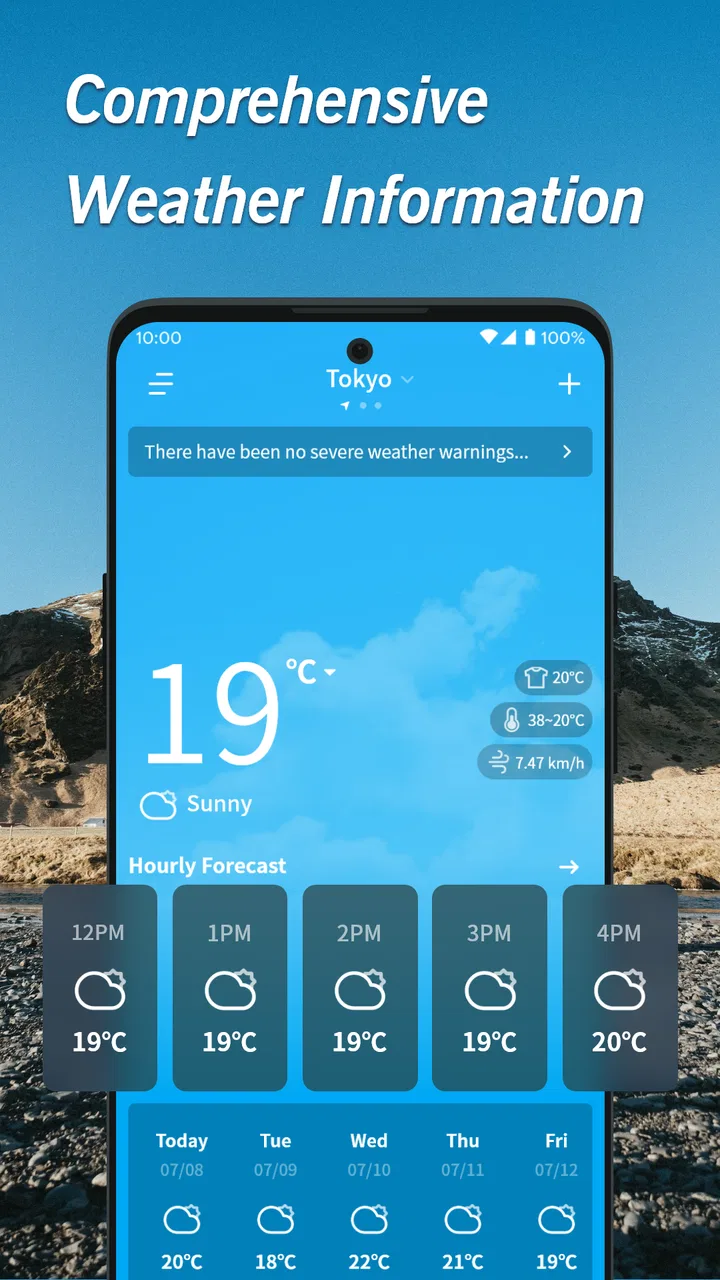
I tend to judge a weather app less by how attractive its forecast looks and more by what happens when I need an answer quickly. Warm Weather, developed by LKW ELE, takes a straightforward place in the weather category: it is a free app for checking conditions without turning a simple question into a complicated routine. Its store summary calls it a personal weather assistant, while the short description points toward warm-weather information. In everyday use, that makes it most appealing to people who want a quick look before leaving home, rather than a full professional forecasting workstation.
The app is available to an Everyone audience and runs on Android devices using version 6.0 or later. The current release is 1.1.8, and its listing shows more than a million installs with an average score of 4.1 from roughly six thousand ratings. Those figures suggest that it has found a broad audience, but they do not remove the need to test it against your own routine. Weather apps are highly dependent on location access, network quality, device settings, and the way each person interprets a forecast.
Getting past the first points of friction
My first advice is not to judge Warm Weather during the first few seconds after installation. A weather app can appear empty, inaccurate, or slow when the real issue is that the phone has not yet supplied a usable location or the connection is temporarily weak. The most common early mistake is opening the app indoors, declining a location request, and then assuming the app has no way to show a local forecast.
You May Also Like

 AccuWeather: Weather Radar
AccuWeather Review: A Quick, Clear Forecast for Everyday Decisions
For everyday plans, the best forecast is the one you can understand quickly. AccuWeather makes rain timing, radar, and local conditions easy to act on, with a few trade-offs.

 Hill Climb Racing
Why Hill Climb Racing Still Turns Crashes Into One More Run
A tiny car, a bumpy hill and one more upgrade: Hill Climb Racing keeps resurfacing because its simple chaos makes every near-miss feel personal.

 AliExpress - Shopping App
AliExpress Makes Global Shopping Feel Personal, but Shoppers Bear the Risk
AliExpress turns a global marketplace into a pocket-sized discovery engine. Its reach is useful, its shopping loop compelling, and its trade-offs easy to miss.

 Lords Mobile: Kingdom Wars
Lords Mobile Is a Kingdom-Building Routine, Not a Quick Match
A case-by-case verdict on the building, battles, device demands, and social commitments that make Lords Mobile rewarding for some players and exhausting for others.

 PDF Scanner app - TapScanner
TapScanner Makes Paperwork Easier to Capture, Check, and Share
TapScanner makes scanning with a phone feel less like a rescue operation and more like a dependable step in getting work done. Its capture tools are useful, though not flawless.

 Block Blast!
 Shows How Much a Puzzle Game Can Leave Out
A quiet grid game shows why puzzle players increasingly value instant clarity, repeatable skill and low-pressure play—and where the genre still needs to catch up.
More From Our News Desk
View All News


If you prefer not to share your position, check whether the app offers a manual way to choose a place during setup or from its main screen. I would not grant access automatically just because the prompt appears. Instead, decide whether automatic local weather is important to you. Someone who checks conditions only for one town may be happier selecting that place manually, while a commuter, traveler, or outdoor worker may find location-based convenience more useful.
There is also a practical difference between a permission being granted and a phone actually allowing an app to use it reliably. Android can restrict location access, limit background activity, or apply battery-saving rules. If Warm Weather repeatedly shows the wrong place, I would first check the system location setting and the app’s permission page before reinstalling anything. A restart is also worth trying after changing access, especially if the app was already open when the setting changed.
The best setup is the one that matches how you really check the weather. If you only need a morning glance, manual location selection can reduce unnecessary interruptions. If you move between places, automatic location may save time but can also require more careful attention to the phone’s location controls. This is a small trade-off, yet it affects whether the app feels dependable.
What to check before blaming the forecast
When the screen does not refresh, I work through the simple causes in order. I confirm that another app can reach the internet, switch between Wi-Fi and mobile data if available, and then reopen Warm Weather. If the phone is in a low-power mode, I temporarily check whether that mode is delaying updates. None of these steps changes the forecast itself, but they help separate a display problem from a data problem.
I also look at the selected location carefully. A nearby town can have noticeably different conditions from a coastal area, a hill, or a dense city center. If the app appears to show an unexpected forecast, the first question should be whether it is using the place I intended. This is especially important after traveling, restoring a phone, or changing language and regional settings.
Another useful habit is to give the app a moment after opening it instead of immediately tapping through several screens. A first load may take longer than a later check, particularly when the phone has been offline or the app has not been opened recently. If the information remains unchanged after a normal refresh and a stable connection, then it is reasonable to compare the same location in another trusted weather source before making an important decision.
A calmer recovery routine when something looks wrong
For a frozen screen or an incomplete load, I would close the app normally and open it again. If that does not help, I would force-stop it through Android’s app settings, then relaunch it. Clearing temporary cache data can sometimes remove a damaged local session without deleting every setting, but I would use that step carefully and avoid clearing storage unless I am prepared to set the app up again.
Reinstalling is a last resort, not the first response to a single inaccurate-looking forecast. It takes time, may reset the selected location, and does not fix a network outage or a wider forecasting discrepancy. Before doing it, I would check whether other weather services show similar conditions. If they do, the issue may be the underlying forecast rather than Warm Weather’s installation.
When the app behaves normally after reopening but fails again later, I would inspect battery and background restrictions. Some phones are aggressive about stopping apps that are not used often. That can make a weather tool seem unreliable even though it works correctly whenever opened directly. The right fix varies by Android manufacturer, so I would use the phone’s own battery settings rather than installing a separate “optimizer” that could create more interference.
One of the more useful ways to use this app is as a quick decision checkpoint instead of a constant notification source. I open it before choosing clothes, packing for a short trip, or deciding whether a walk is sensible. If the first screen gives me enough information for that decision, I stop there. This keeps the app focused and avoids treating a short-term forecast as a guarantee.
Everyday situations where it earns its place
Imagine leaving for work on a mild morning with a long walk between public transport stops. I would open Warm Weather, check the selected location, look at the expected conditions, and decide whether a light jacket or umbrella belongs in my bag. The value is not in staring at the screen all day; it is in making that small decision before stepping outside.
It can also suit parents checking the day before school, people planning a market visit, or anyone who wants a simple weather reference on an older Android phone. Since the app supports devices from Android 6.0 onward, it may be a practical option for users who cannot or do not want to move to a newer phone just to run a modern weather tool.
For travel, I would use it as one part of a preparation routine. I would select the destination, confirm that the location has changed correctly, and check again close to departure. I would not rely on one app alone for safety-critical activities, long hikes, boating, aviation, or severe-weather decisions. A general weather app can be convenient without being a substitute for official warnings or local emergency information.
Warm Weather is also more comfortable for people who dislike overly busy weather dashboards. Many alternatives fill the screen with maps, radar layers, alerts, advertising panels, and long-range charts. Those tools can be excellent when you need detail, but they increase the time needed to interpret a basic forecast. This app’s appeal is its narrower purpose: open it, orient yourself, and make a normal daily decision.
Where other weather apps may be the better choice
I would choose a different weather app if my priority were advanced radar, detailed storm tracking, specialist outdoor planning, or extensive historical information. Those needs call for tools designed around maps, layers, alerts, and technical readings. Warm Weather should not be treated as a replacement for every type of weather service simply because it is easy to open.
I would also hesitate to make it my only source when a forecast has serious consequences. If a road trip depends on rapidly changing conditions, I would compare several sources and read official local advisories. Forecast differences are not automatically proof that one app is broken; weather models, update timing, and location selection can all produce different results.
There is a second trade-off for people who want extensive personalization. A lightweight weather experience can feel clean, but users who expect many widgets, notification controls, saved locations, or detailed historical views may find a larger established service more suitable. I would not install Warm Weather expecting it to behave like a full weather center. Its strength is the short path from opening the app to understanding the day.
The rating of 4.1 indicates a generally positive reception, although it is not a reason to ignore individual behavior on your device. Android phones differ widely in screen size, system restrictions, location handling, and network conditions. I would use the app for a few ordinary days, including one day when traveling to another area, before deciding whether it fits my routine.
Small habits that make the experience more dependable
I keep the selected place visible in my checking routine, especially after a journey. This prevents a surprisingly common error: reading a perfectly reasonable forecast for the wrong town. I also compare the forecast with what I can see outside, not to dismiss the app, but to notice whether a stale screen or delayed refresh is involved.
For a planned outdoor activity, I check at more than one time rather than treating an early glance as final. A forecast is a changing estimate, and the usefulness of any weather app depends partly on when it is consulted. Warm Weather works best when I use it as a current reference, not as a promise about conditions many hours later.
If the app stops updating, I avoid repeatedly tapping refresh while the phone has a poor signal. I first restore a stable connection, reopen the app, and check the location. This saves battery and makes troubleshooting clearer. If the same problem appears across several days while other internet apps work normally, then I would consider resetting the app or looking for an available update through the official app store.
For older devices, I would keep expectations realistic. Compatibility with Android 6.0 or later is helpful, but performance still depends on the phone’s memory, storage, and system condition. Closing unused apps, keeping reasonable free storage, and restarting the phone occasionally can help any weather app launch more smoothly. These are general maintenance steps, yet they matter more when a device is several generations old.
My practical verdict after using it as a daily tool
Warm Weather is a sensible choice for someone who wants a free, approachable weather app and does not need a technical forecasting suite. I like the idea of using it as a quick morning assistant: confirm the place, check the current outlook, and get on with the day. Its broad compatibility makes it worth considering for older Android phones, and the Everyone age rating keeps it suitable for a wide household audience.
My recommendation comes with clear boundaries. I would not choose it as my only resource for dangerous weather, specialist outdoor work, or detailed map-based planning. I would also skip it if my main reason for installing a weather app is a large collection of advanced tools. In those cases, an alternative built around radar, alerts, or professional-level detail will probably save frustration.
For ordinary decisions, however, the app has a useful role. The most important step is setting the location correctly and understanding that a failed refresh may be caused by connectivity, permissions, or battery controls rather than the forecast service itself. Once those basics are handled, Warm Weather can remain a low-effort part of a daily routine rather than another app that demands constant adjustment.
After weighing its simplicity against those limitations, I would recommend it to casual users, families, commuters, and owners of older Android devices who want a direct weather check. I would tell a friend to try it for several days, use it alongside official alerts when conditions matter, and keep a more specialized alternative in mind if the need for radar or detailed planning grows. It is best understood as a practical first check, not a complete weather command center.
FAQs for Warm Weather
01What is the main purpose of the Warm Weather app?
The Warm Weather app is designed to provide users with accurate and up-to-date weather forecasts. It offers real-time data, customizable notifications, and detailed weather reports to help users plan their activities accordingly. Its intuitive interface makes it easy for users to access information about temperature, humidity, wind speed, and other meteorological details.
02Is the Warm Weather app free to use, or does it require a subscription?
The Warm Weather app is free to download and offers basic weather features at no cost. However, for advanced features such as ad-free browsing, extended forecasts, and premium widgets, the app offers a subscription plan. Users can choose between monthly or yearly subscriptions based on their preferences.
03How accurate is the weather forecast provided by the Warm Weather app?
The Warm Weather app utilizes data from multiple reliable sources and advanced meteorological models to ensure high accuracy in its forecasts. The app updates its information frequently and provides real-time alerts for sudden weather changes, making it a dependable choice for users who need precise weather predictions.
04What devices are compatible with the Warm Weather app?
The Warm Weather app is compatible with both Android and iOS devices. It supports a wide range of smartphones and tablets, ensuring smooth performance across different operating systems. Users can download the app from the Google Play Store or the Apple App Store, depending on their device.
05Does the Warm Weather app offer any customization features?
Yes, the Warm Weather app provides several customization options. Users can personalize their weather experience by selecting different themes, setting up location-based alerts, and choosing the units of measurement they prefer. The app also allows users to add multiple locations to keep track of the weather in different areas.
Pros
- User-friendly interface for quick navigation.
- Accurate local weather forecasts.
- Customizable notifications for weather alerts.
- Beautiful and clear weather visuals.
- Minimal data usage even with frequent updates.
Cons
- Lacks advanced features for weather enthusiasts.
- Occasional lag on older devices.
- Advertisements can be intrusive at times.
- Limited international city coverage.
- No offline mode for weather updates.

Warm Weather
Gallery